

















You can scroll vertically


Spreading a Barrier-Free Mindset Through Toys
"Making toys that everyone can enjoy" to achieve "company management that is beneficial to society."
These words left by our founder, Eiichiro Tomiyama, are the starting point of our activities.
We invite you to play with TOMY toys.
Regardless of whether you have a disability or not, you will find various considerations designed to allow everyone to play together.
We believe that children who experience the joy of playing together, transcending differences and respecting individuality, will grow into adults who will build a society where everyone can live together.
What are
Accessible-Design
Toys?
This section is for parents and children to view together to pursue independent research projects and learn more.
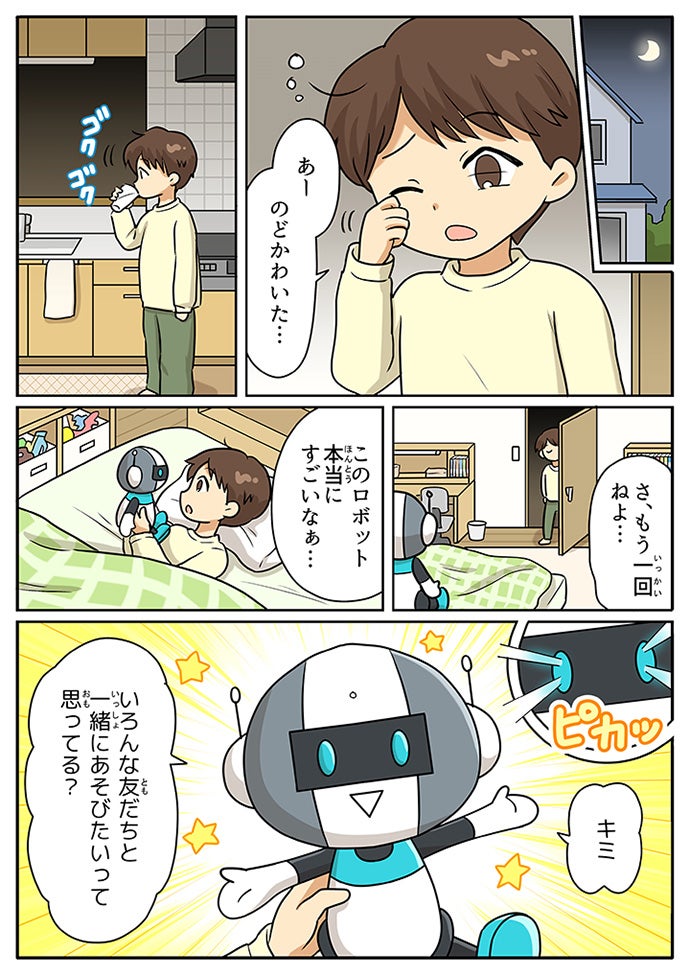
1
“Ah, I’m thirsty...”
Gulp gulp
2
“Okay, back to bed...”
“This robot is so cool...”
3
Flash
“Hey there.
Don’t you want to have fun with more friends?”
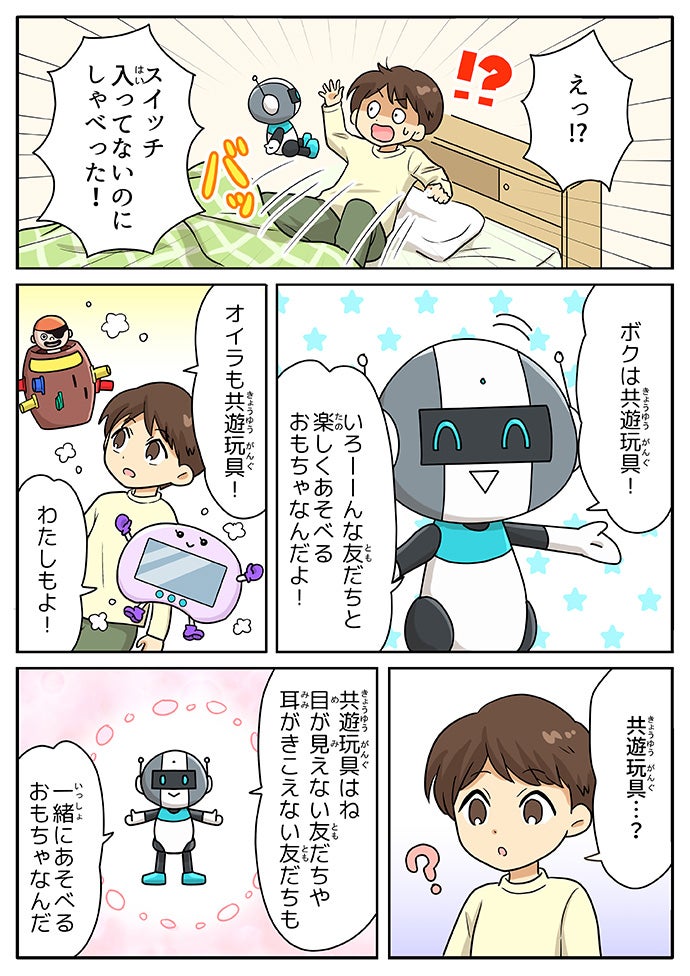
4
“Wha-!?
It talked! And it’s not even switched on!”
Jump
5
“I’m an accessible-design toy!
I’m a toy that lets you have fun with more friends!”
“I’m an accessible-design toy too!”
“Me too!”
6
“Accessible-design toy...?”
“Accessible-design toys are toys that friends who can't see or hear
can enjoy playing, too! ”
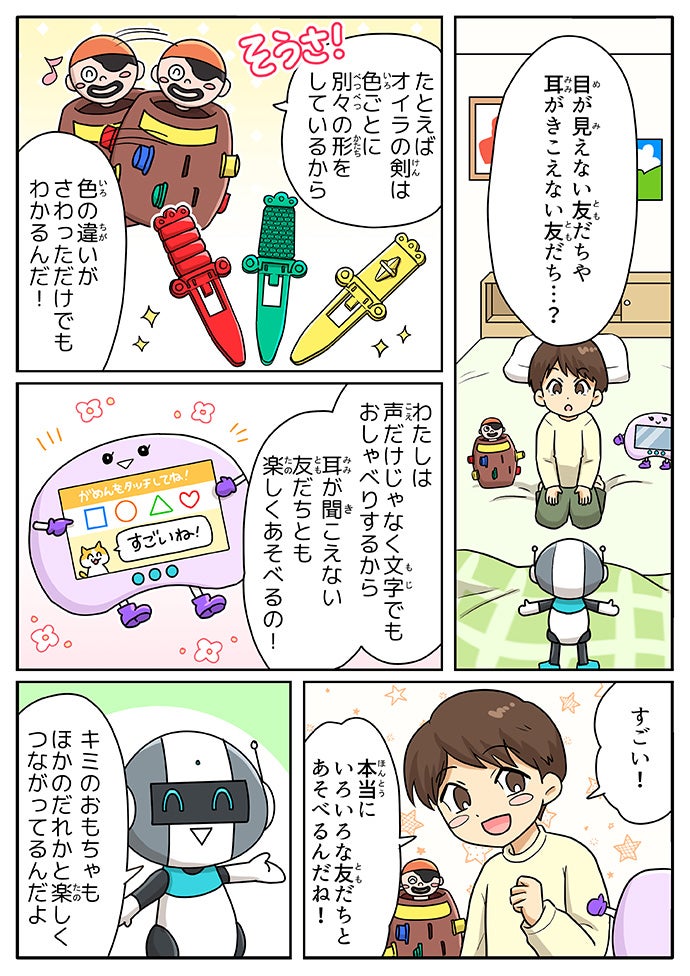
7
“Friends who can’t see and friends who can’t hear...?”
“That’s right!
look! my swords have different shapes for each color,
so you can tell the difference in color just by touching them!”
“I speak not only with voice but also with text,
so you can enjoy playing with friends who can’t hear, too!”
8
“Wow!
With you guys, I can really play with more friends!”
Your toys will help you make more friends, too.
9
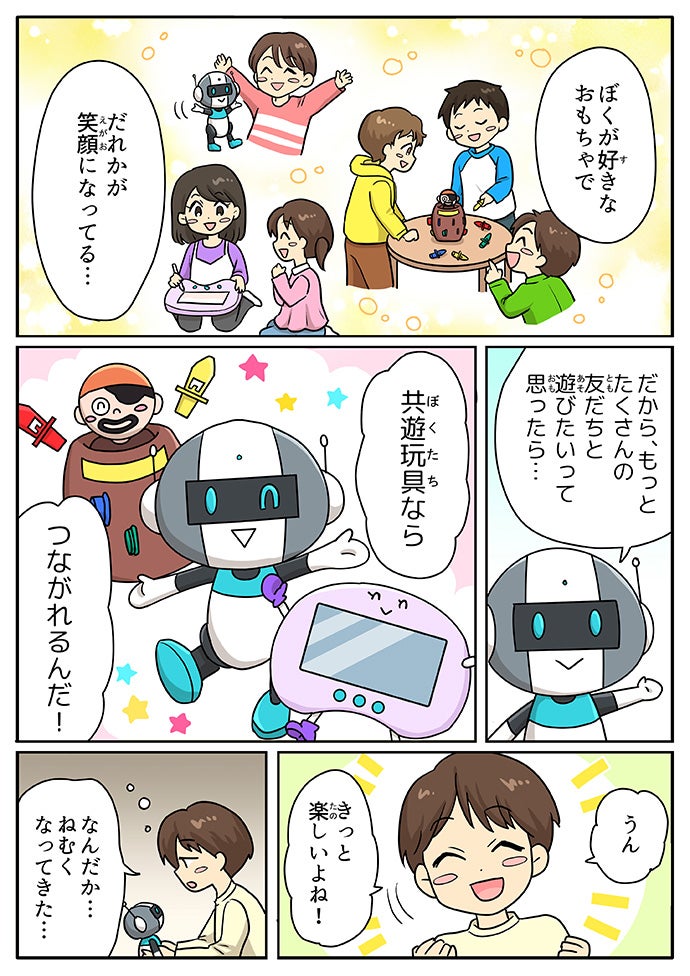
“My favorite toys
Could help make someone smile...”
10
“So, if you want to enjoy playing with even more friends...”
“With us accessible-design toys,
you can connect!”
11
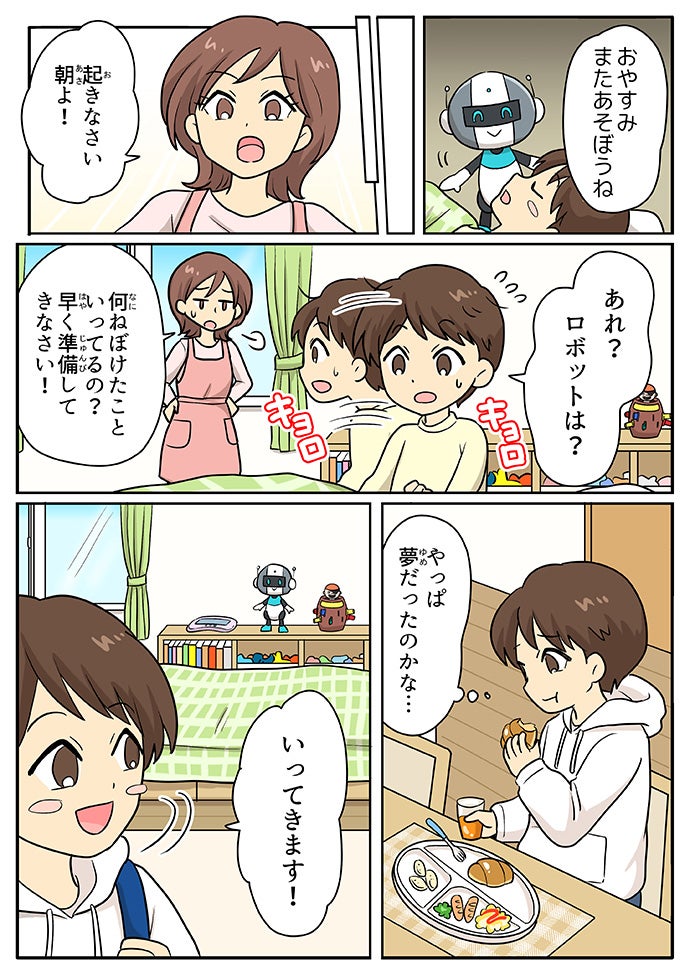
“Yeah.
I bet it’d be fun!
I’m getting... sleepy...”
12
“Goodnight. Let’s play again soon.”
“Up you get! It’s morning!”
13
“Oh? Where’s the robot?”
Look
Look
“You’re still half-asleep! Hurry up and get ready!”
14
“I guess it was a dream after all...”
“I’m off!”
15
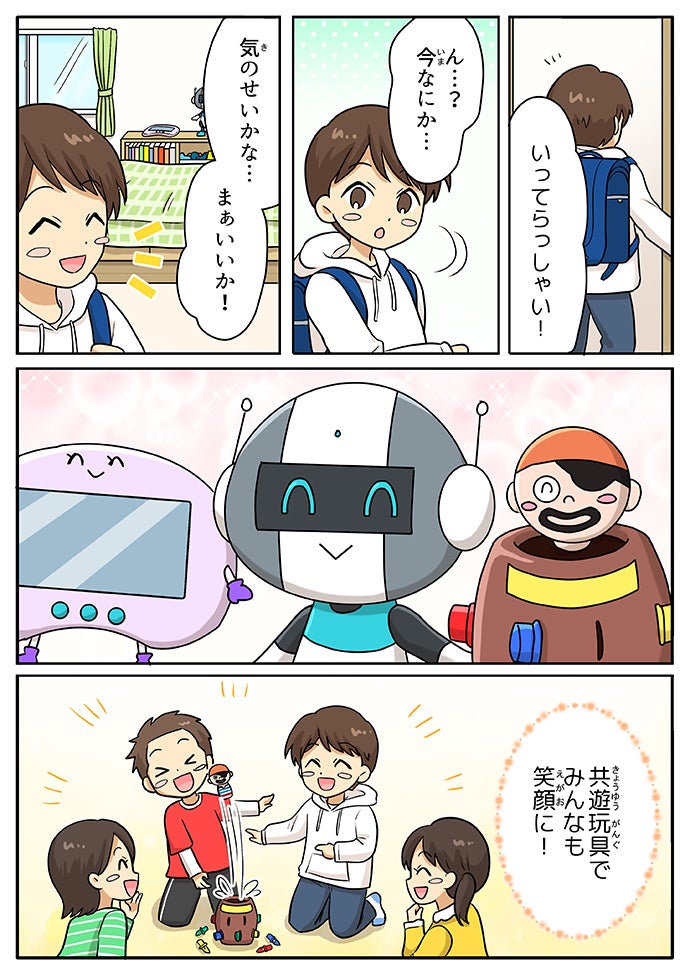
“Have a good day!”
“Hmm...? Did I just...
Must have imagined it... Oh well!”
16
Accessible-design toys bring a smile to everyone!
Toys that you can enjoy playing with together with friends who have visual or hearing disabilities are described as “toys for playing together” and known as “Accessible-Design Toys”!
* Some products introduced in the video may no longer be available for purchase as production has ended.
* Japanese Only

Guide Dog Mark
& Rabbit Mark
This section is for parents and children to view together to pursue independent research projects and learn more.
Do you know what these marks are?

1
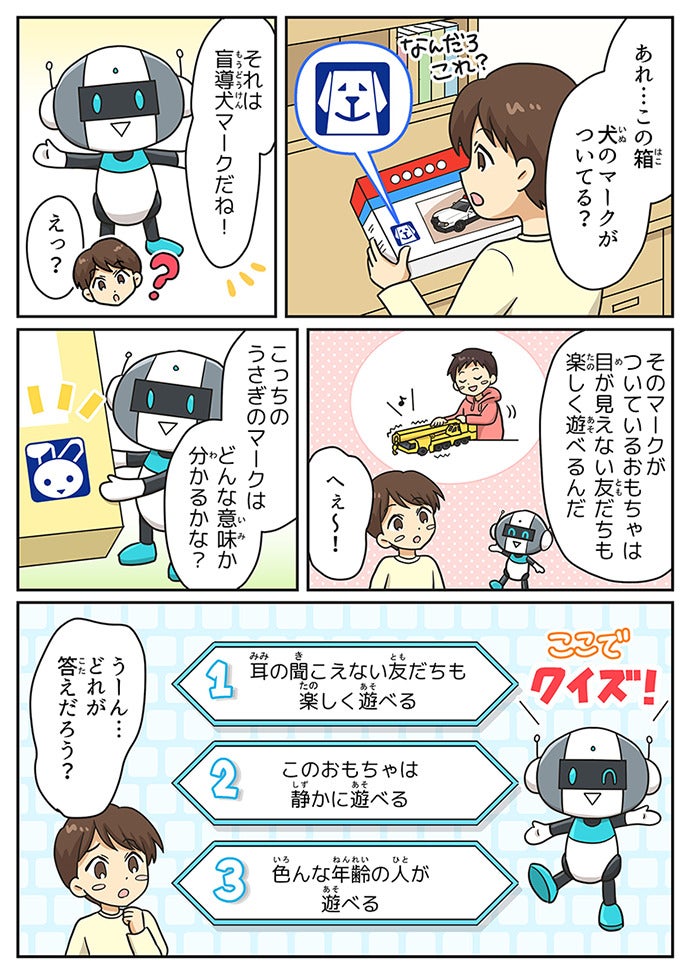
“Huh... this box, it has a dog mark on it?
What is this?”
“That’s the Guide Dog Mark!”
“Eh?”
2
“Toys with that mark are fun to play with for friends who can’t see, too!”
“Really!?”
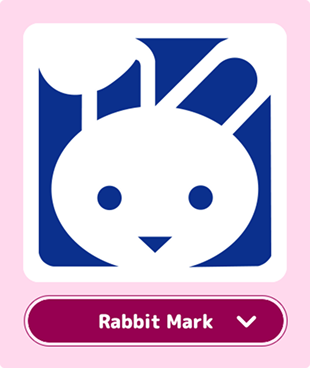
“Can you guess what this Rabbit Mark means?”
3
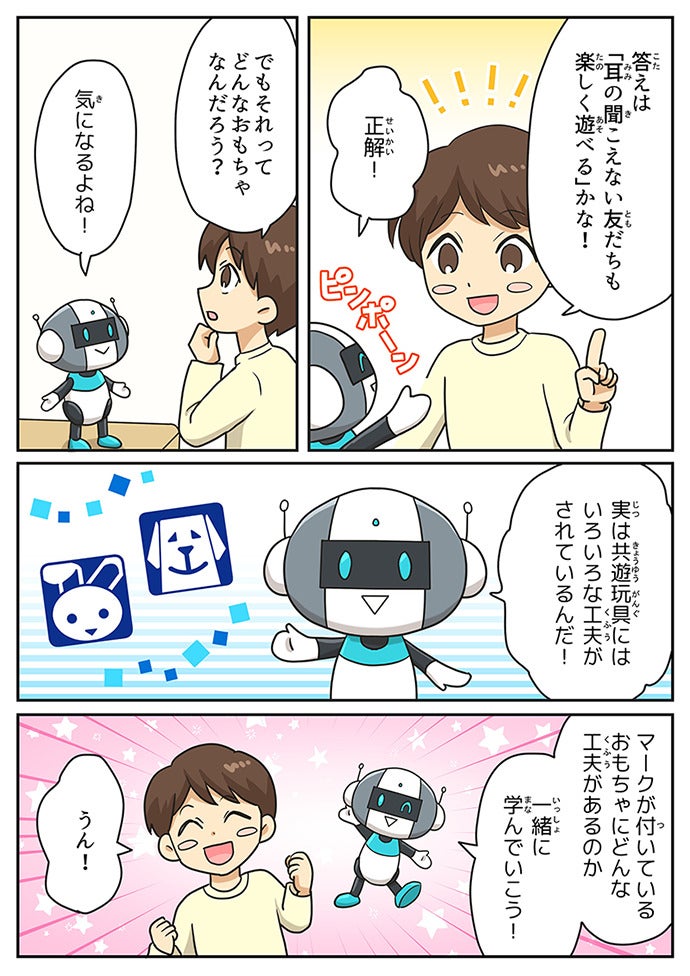
“Here’s a quiz!
Which one of the following is the correct meaning of Rabbit Mark?”
- Friends who can’t hear can also enjoy playing
- This toy can be enjoyed quietly
- People of various ages can play”
“Hmm... which is the answer?”
4
“Is it... “Friends who can't hear can also enjoy playing”?”
“Ding Dong
Correct!”
“But what makes them so special?”
“I bet you’re curious!”
5
“Actually, various innovations are built into accessible-design toys!”
6
“Let’s see together what kind of innovations are in toys with these marks!”
“Yeah!”
What is the
Guide Dog Mark?

This puppy mark is called the “Guide Dog Mark,” and it’s attached to toys that are recognized as being enjoyable for friends with visual disabilities too!
Persons with visual disabilities use their sense of touch and sound as cues to play instead of seeing.
When “innovations” for that purpose are incorporated into a toy, it becomes an excellent accessible-design toy!

Innovation to tell if it is ON or OFF by touch
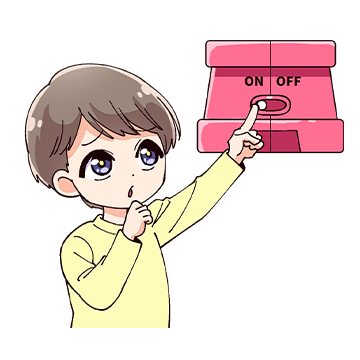
You want friends who can’t see to know which side is the switch “ON”!
What kinds of innovations can you make?
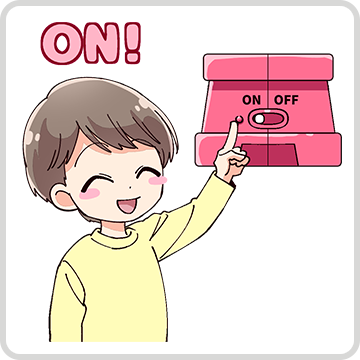
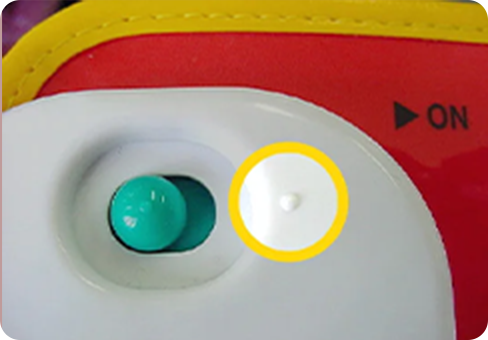
If there is a raised dot (Tactile Mark) on the “ON” side of the switch, you can tell which side is “ON” just by touching it!

Innovation to find the screw hole for opening the battery box by touch
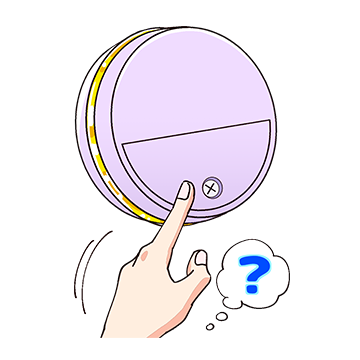
You want friends who can’t see to know which screw hole opens the battery box!
What kinds of innovations can you make?
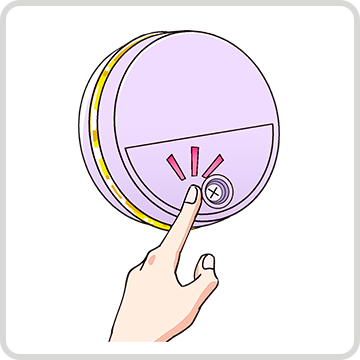
If the area around the screw hole that opens the battery box is raised in a donut shape, friends who can’t see can tell just by touching it!

Innovation to tell what color is glowing by the toy’s voice
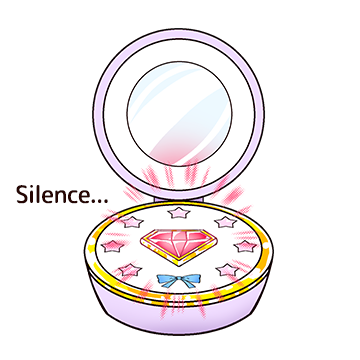
You want friends who can’t see to know what color it glowed!
What kinds of innovations can you make?
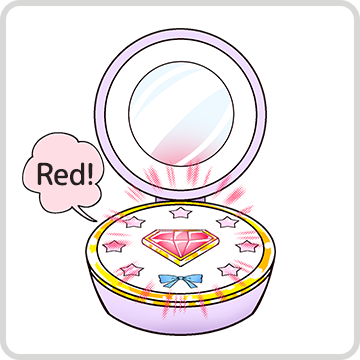
If the toy speaks or makes unique sounds to tell you the color it is glowing, friends who can’t see can enjoy playing too!

Innovation to identify types not just by appearance, but also by touch
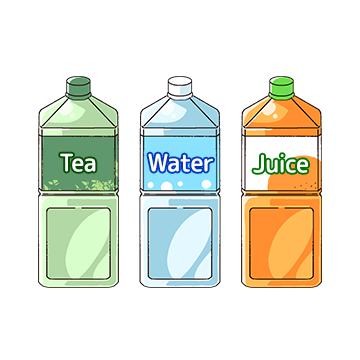
You want friends who can’t see to know that the contents of the bottles are different!
What kinds of innovations can you make?
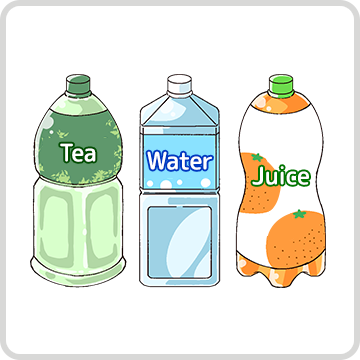
If we change the shape of the bottle for each type of contents, you can tell the difference even by touching!

Innovation to prevent balls from rolling far away
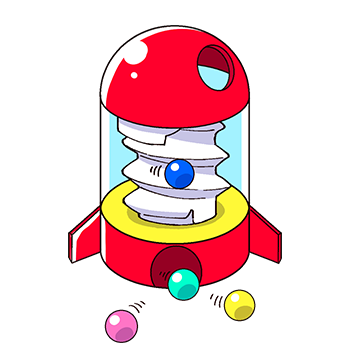
You want friends who can’t see to be able to easily pick up rolling balls!
What kinds of innovations can you make?
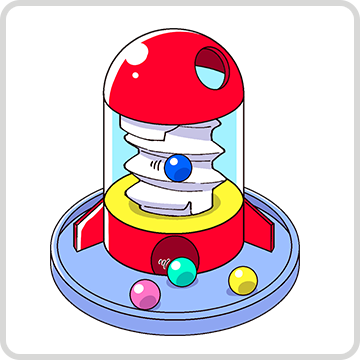
If a frame is attached so the balls do not roll far away, friends who can’t see can easily pick them up!

Innovation to prevent shifting or falling over when touched
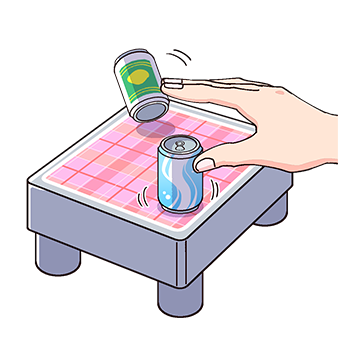
You want to prevent things on the table from easily shifting or falling over when felt with fingers!
What kinds of innovations can you make?
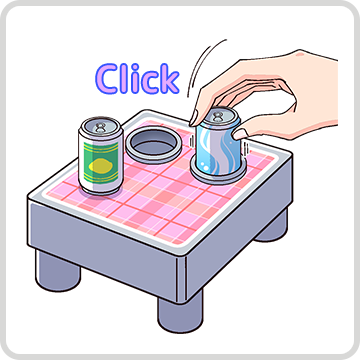
If a recess are made on the table, the can won’t easily shift or fall over even if you touch it!

Toys that enable you to feel the shapes of things you can’t usually get to touch

You want to tell friends who can’t see how an airplane looks like!
What would you do?
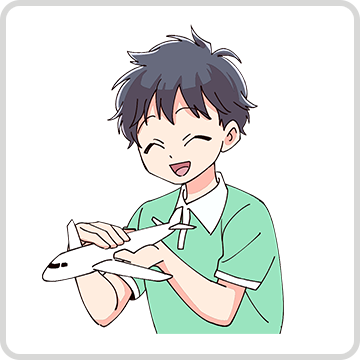
If you use an airplane toy small enough to feel the shape, your friends can touch it and know how it looks like!

Toys that let you know the shapes of things appearing on TV and in picture books
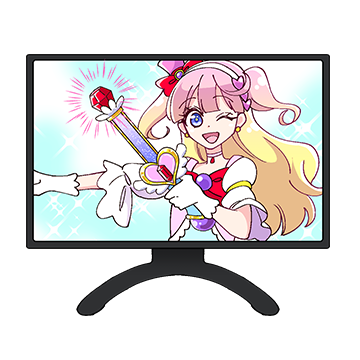
If you couldn’t see, you’d want to touch the things that appear on TV and picture books too!
How can you make them touchable?
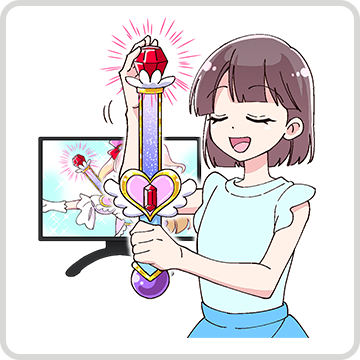
If you make characters and items on TV and picture books into toys, you can know their shapes by touching them.

Toys with Braille stickers
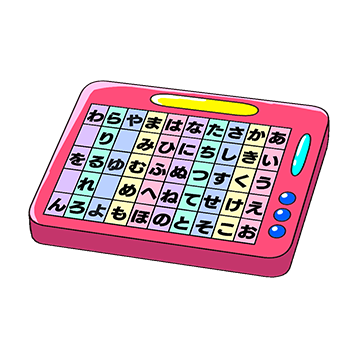
You want friends who can’t see to know where and what are printed!
What kinds of innovations can you make?
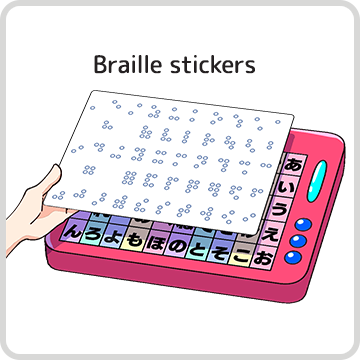
If you attach stickers with Braille on them, friends who can’t see can read them too.
What is the
Rabbit Mark?

This bunny mark is called the “Rabbit Mark,” and it’s attached to toys that are recognized as being enjoyable for friends with hearing disabilities too!
Most toys on the market can be enjoyed even without being able to hear their sounds.
However, if sound is a key point of play, such as only knowing if you “won” or “lost” by sound, you can’t fully enjoy the toy.
When “innovations” for that purpose are incorporated into a toy, it becomes an excellent accessible-design toy!

Innovation to show the toy’s speech as text
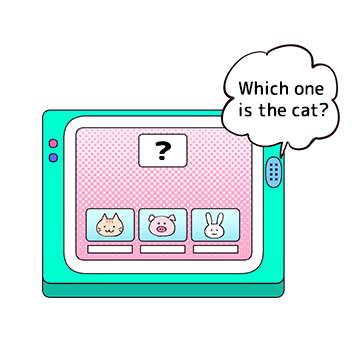
You want friends who can’t hear to know what the toy is speaking!
What kinds of innovations can you make?
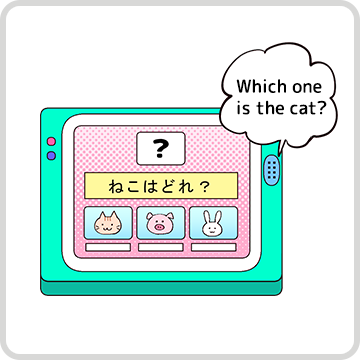
If you make the words the toy is speaking visible as text or pictures, friends who can’t hear can see and enjoy too!

Innovation to show the loudness of the toy’s sound visually
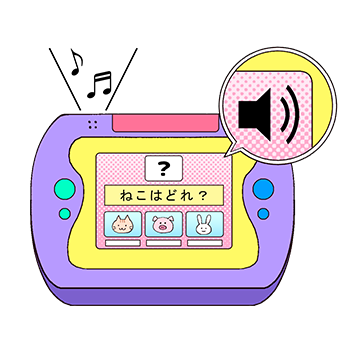
You want friends who can’t hear to know how loud (or soft) the sound is!
What kinds of innovations can you make?
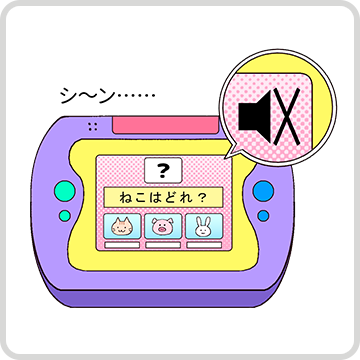
If you show the loudness of the toy’s sound as an icon, friends who can’t hear can see it too!

Toys where movement indicates that a sound has been made nearby
Friends who can’t hear also have times when they want to know that a sound has been made nearby!
Is there anything you can do with a toy?
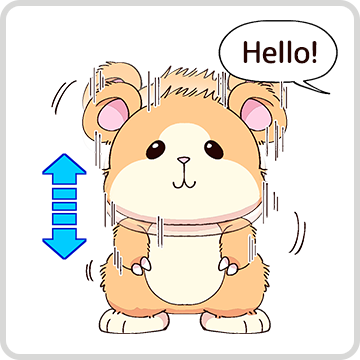
If there were a toy that moves when a sound is made nearby, friends who can’t hear would know about it.

Innovation where the toy moves with the sound to enhance the fun
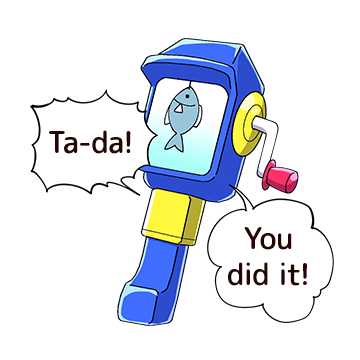
You want to convey the fun of the sound coming from the toy to friends who can’t hear too!
What kinds of innovations can you make?
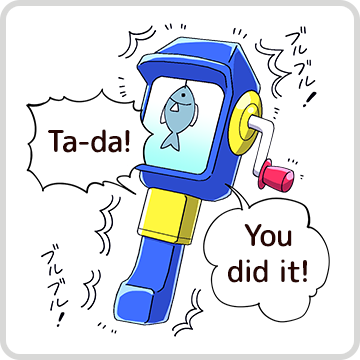
If the toy moves along with the sound, friends who can’t hear can enjoy it too!

Toys that allow conveying feelings through text and pictures
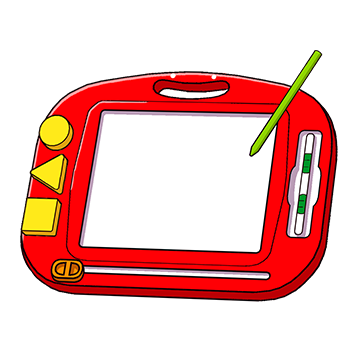
You want to chat with friends who can’t hear too!
Is there anything you can do with a toy?
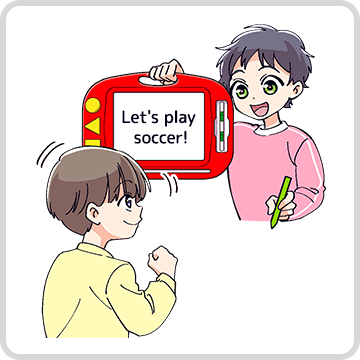
If there were a toy where you can easily draw text or pictures, you could convey your feelings to each other.
1
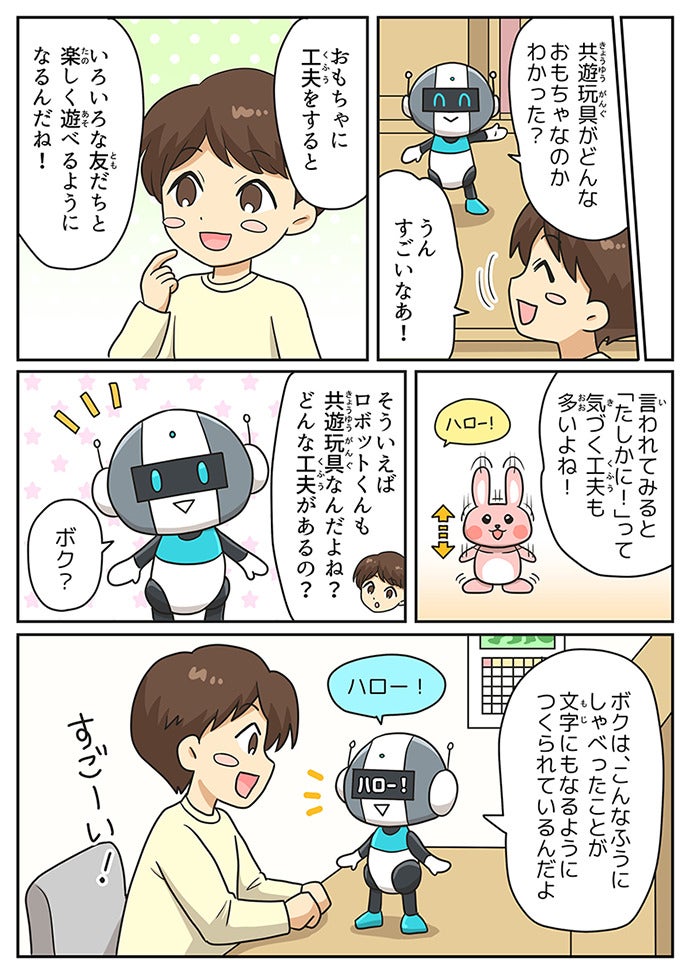
“Do you get what accessible-design toys are now?”
“Yeah, they’re amazing!”
“If you add innovations to toys...
You can play and have fun with many more friends!”
2
“Come to think of it, I’ve seen a lot of things that make me go, “Oh, I get it!””
Hello!
“Wait, you’re an accessible-design toy too, aren’t you, Robot? What kind of innovations do you have?”
“Me?”
3
“I am built so that what I speak becomes text like this.
Hello!”
“Wooow!”
4
“Does that mean accessible-design toys...
Are all around me?”
5
“That’s right!
Even around you all...”
6
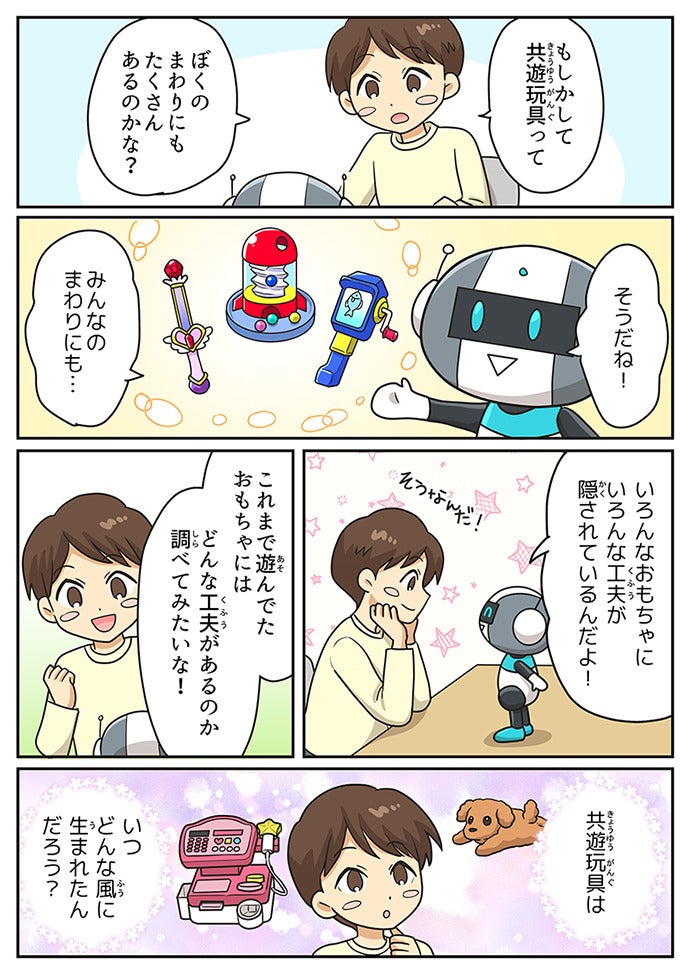
“There are various innovations hidden in all kinds of toys!”
“I see!”
I wanna check my old toys and see what innovations are hidden inside!”
7
“Accessible-design toys...
When and how did they come about?”
TOMY’s Initiatives
From “Specialized”
to “Accessible.”
Here we introduce the history of TOMY’s initiatives aiming for toys that everyone can play with together.
1
“Toys that friends who can’t see or hear... huh.
can enjoy too, huh...”
2
“Right! Even me”
Pop
“Whoa!
Of course. Robot is an accessible-design toy too!
But I didn’t switch you on, did I?”
3
“You’re wondering how these accessible-design toys were born, aren’t you?”
“Yeah, I was wondering how toys for everyone got started...”
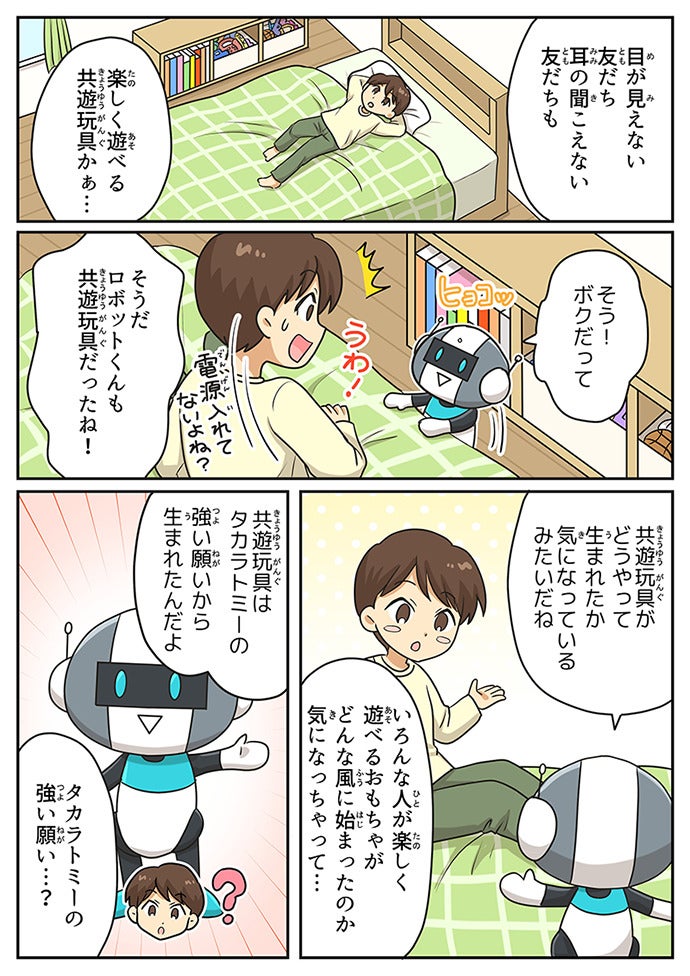
“Accessible-design toys were born from TOMY’s strong desire.”
“TOMY’s strong desire...?”
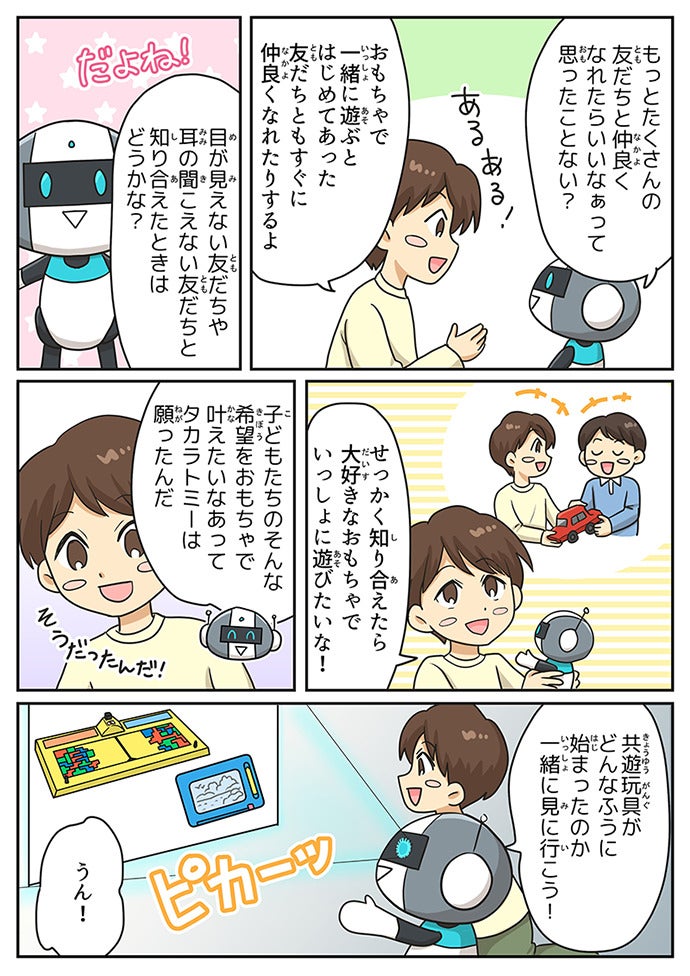
4
“Have you ever wished you could make more friends?”
“All the time!
If you play together with toys, you can become friends immediately, even with someone you’ve just met.”
“Totally!
But how about when you meet a friend who can’t see or a friend who can’t hear?”
5
“I’d still want to play with my favorite toys with them!”
“TOMY wanted to grant these children’s wishes through toys.”
“So that was it!”
6
“Let’s go see together how accessible-design toys started!”
Flash
“Yeah!”

Establishment of the
“HT Laboratory”
It was in 1980, over 30 years ago, that TOMY began thinking about children with disabilities.
This was a manifestation of the founder Eiichiro Tomiyama’s desire for “toys that everyone can enjoy” and “corporate management that benefits society,” and the “HT Laboratory” was established to specialize in developing toys for children with disabilities.
Members of the HT Laboratory visited various facilities and carefully investigated what kind of toys were appreciated and what kind of toys were needed.
And so, they decided to first tackle toys for children who cannot see.

Even though
they were
a big hit...
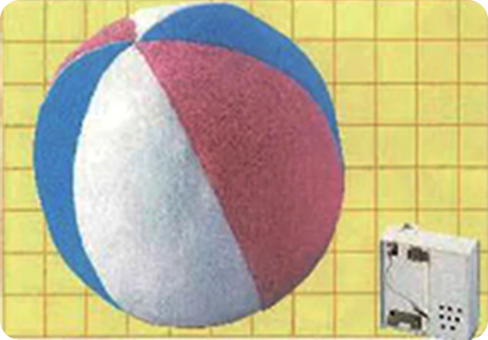 Melody Ball, a ball that makes sound with a vibration sensor
In response to comments saying, “Balls with bells inside are fun, but once the ball stops moving, we don’t know where it is,” we developed the Melody Ball, which contained a melody chip with a vibration sensor, as a toy exclusively for children with disabilities, and it gained popularity.
Toys made at the HT Laboratory were not intended for the general market and were all sold at specialized facilities where only people with visual disabilities came to shop.
Therefore, even if it was a “big hit,” the sales numbers were small, and it was impossible to make a profit.
Initially, we proceeded with the idea that this did not matter because it was social contribution, but amidst the recession of the late 1980s, it became difficult to continue this activity.

The Birth of Accessible-Design Toys
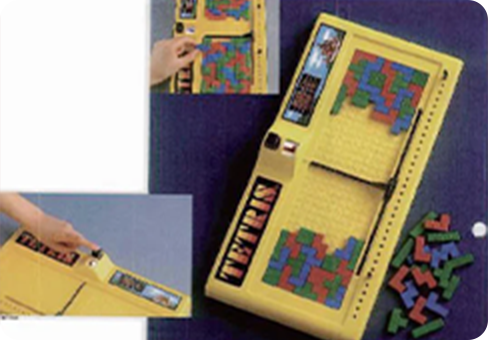
Then, an unexpected proposal came from an employee who was not a member of the laboratory...
“Isn’t it costing money because you’re trying to make them specialized?
If we added slight innovations to ordinary toys, wouldn’t manufacturing costs be kept down, and wouldn’t more children be able to play without discrimination?”
This was the trigger for the birth of “Accessible-Design Toys.”
Ideas that could be implemented without extra cost if noticed during the development stage, such as changing the shape of labels so they can be distinguished by touch or adding a dot on the ON side of a switch, began to take shape little by little.

Spread to the
Entire Industry
The concept of toys that everyone can play with together, which started at TOMY, gathered a lot of support.
Today, it has become an activity that the entire toy industry works on as “Accessible-Design Toys,” toys that children with visual or hearing disabilities can also enjoy playing.
We display the “Guide Dog Mark” and “Rabbit Mark” on the packages of toys certified by the Japan Toy Association to convey this clearly to customers.
Currently, there are over 100 types of toys certified as “Accessible-Design Toys” in the TOMY Group annually.
In addition, to let more people know about the considerations for toys that everyone can enjoy, we engage in activities to promote understanding of disabilities (barrier-free mindset), such as participating in events like the International Home Care & Rehabilitation Exhibition (H.C.R.), giving lectures at universities, and conducting visiting classes at elementary schools.

Aiming for
“Enjoyable for Everyone”
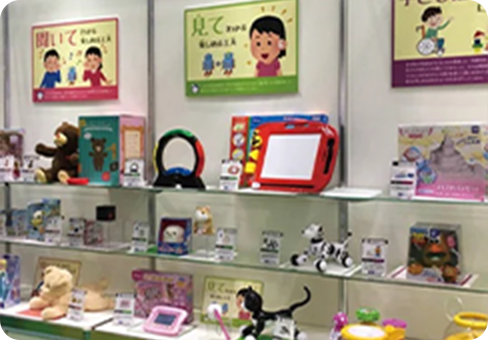
For these achievements in popularization, the TOMY Group received the “Cabinet Office Minister of State for Special Missions Award for Barrier-Free Design and Universal Design” in 2009.
However, we believe we need to extend our considerations to allow even more people to enjoy our toys, in addition to the children with visual or hearing disabilities currently supported by accessible-design toys.
Therefore, we continually conduct monitor surveys with children with disabilities and focus on development.
Moving forward, based on the idea of “Playing Together,” we will strive to evolve our activities so that many people, including more children with diverse characteristics, can enjoy playing.
1
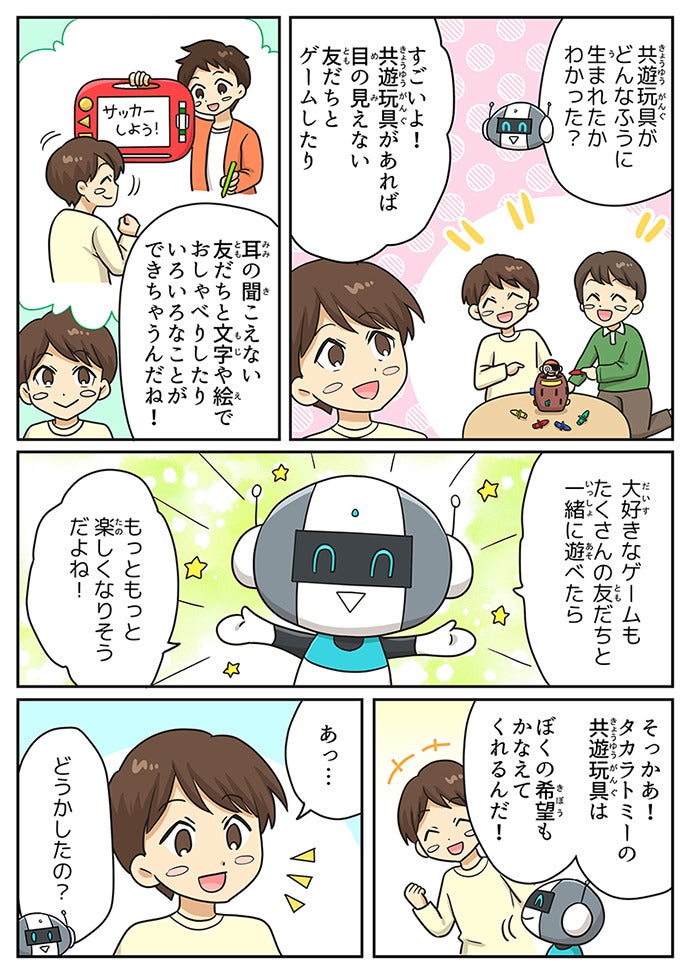
“Do you get how they were started now?”
“It’s awesome! With accessible-design toys, I can play games with friends who can’t see...”
Let’s play soccer!
“And chat with friends who can’t hear using text and pictures, and do all sorts of things!”
2
“If you could play your favorite games with lots of friends...
That sounds way much more fun!”
3
I see! TOMY’s accessible-design toys make my wishes come true too!
Ah...”
“What’s the matter?”
4
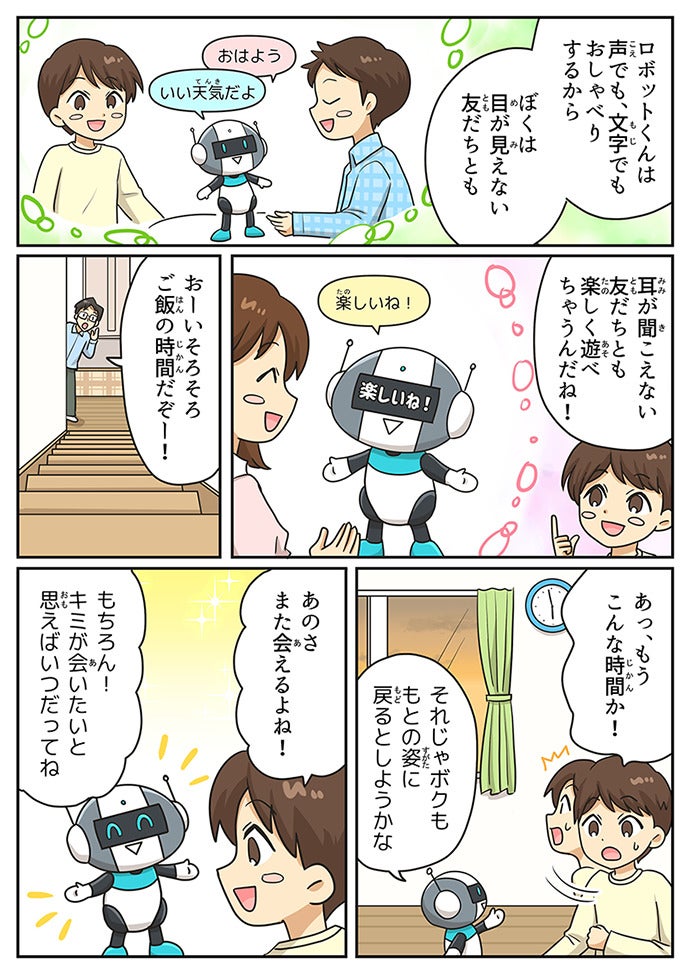
“Since you chat with voice and text, I can play with friends who can’t see…”
“Good morning. ”
“Nice day, isn’t it!”
5
“And friends who can’t hear, too!”
“It’s fun!”
“Hey! Dinner’s almost ready!”
6
“Whoa, is that the time already?”
“Well, I guess I should go back to normal too.”
“Hey... we’ll meet again, right?”
“Of course! Whenever you want!”